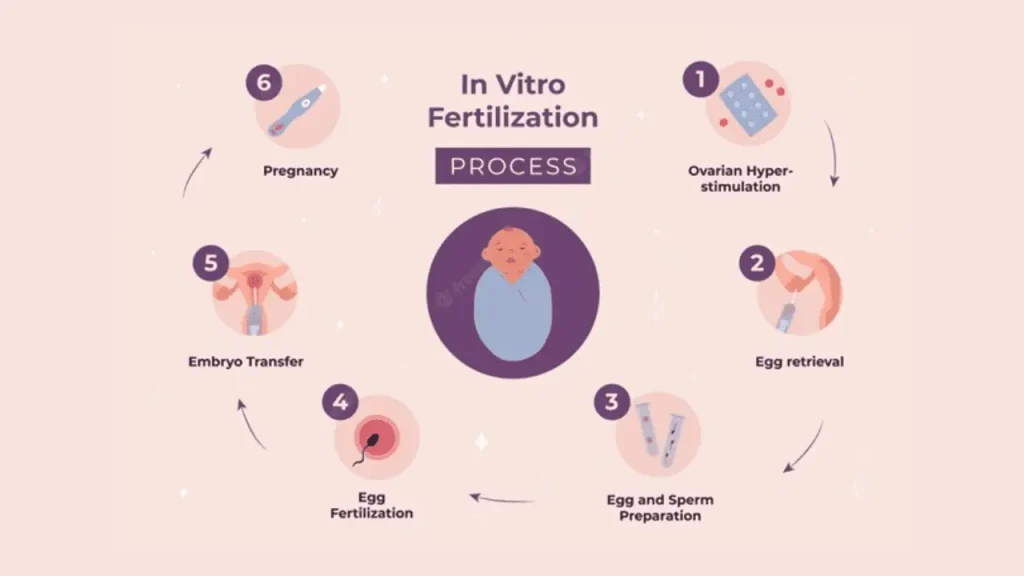
IVF is a fertility treatment in which an egg is fertilized by sperm in a lab, and the resulting embryo is placed into the uterus. It’s carried out in stages over the course of a few weeks.
Fertilization is the moment an egg and sperm join to form an embryo. In a typical conception, fertilization happens inside the body. In IVF, that step is moved to a lab, where conditions can be controlled and the process observed. This is what allows a doctor to step in at the points where conceiving naturally has been difficult.
The IVF Cycle
One round of IVF — also called a cycle — is a single pass through the stages below, from the start of the stimulation medication to the pregnancy test after a transfer. Exact timing and medications vary by clinic and by person.
1
Testing and planning
Before the cycle beginsand planning
Bloodwork, ultrasounds, and a semen analysis give a picture of what’s happening. From these, a doctor designs a medication plan suited to the situation.
2
Ovarian stimulation
About 8–14 days
Daily hormone injections encourage the ovaries to mature several eggs at once, rather than the single egg of a usual cycle. Frequent monitoring tracks how the follicles are growing.
3
The trigger shot
One precisely timed dose
A final injection prompts the eggs to finish maturing. Retrieval is scheduled for roughly a day and a half later.
4
Egg retrieval
A short procedure, ~20–30 min
Under light sedation, the mature eggs are collected from the ovaries using an ultrasound-guided needle. Most people go home the same day.
5
Fertilization in the lab
Embryos develop over 3–6 days
The eggs are combined with sperm — either mixed together, or with a single sperm injected into each egg (ICSI). Successfully fertilized eggs grow into embryos over the following days.
6
Embryo transfer
A quick procedure
A selected embryo is placed into the uterus. This can happen in the same cycle, or — increasingly common — embryos are frozen and transferred in a later cycle.
7
The two-week wait
About 9–14 days
After the transfer comes the wait before a blood test can confirm whether the embryo has implanted.
After the transfer comes the wait before a blood test can confirm whether the embryo has implanted.
One round can mean more than one transfer. A single round of stimulation and retrieval often produces several embryos. One may be transferred while the rest are frozen, and a later attempt can use a frozen embryo without repeating stimulation and retrieval. So “a round” and “a transfer attempt” aren’t always the same thing — a distinction that matters for both cost and what the road ahead may look like.
After the cycle
At the end of the two-week wait, a blood test shows whether the cycle has resulted in a pregnancy. If it has, care moves to a regular pregnancy team. If it hasn’t, the next step is a conversation with the doctor about what to adjust — and whether to try again with a new cycle or with a frozen embryo from this one.